By: Jonothan Milicevic
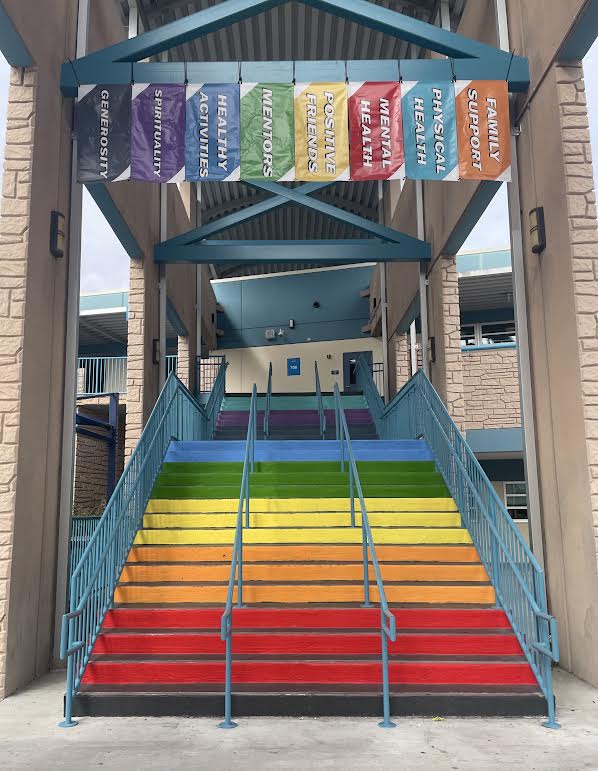
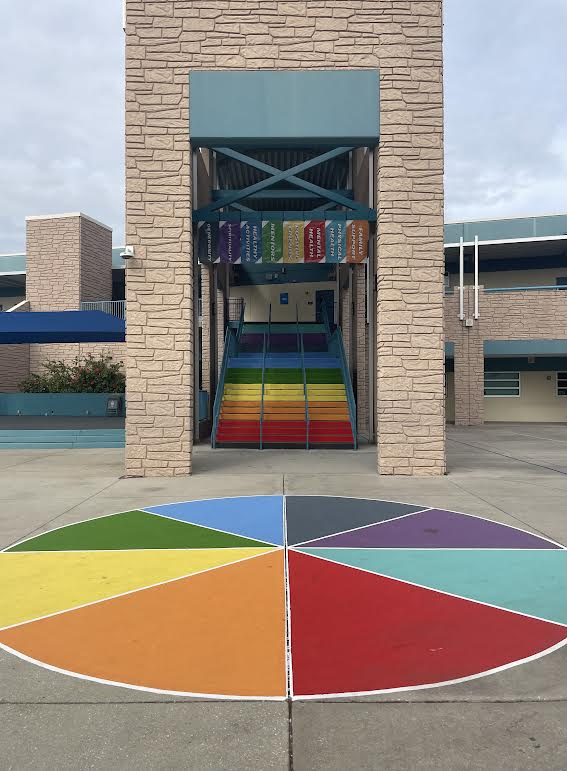
Walking in after Thanksgiving recess, students were surprised to see a fresh paint job on Ponte Vedra High School’s (PVHS) courtyard staircase. The rainbow embellishments have brewed up noticeable controversy at PVHS, and no—they are not ‘gay.’
The initiative to paint the stairs was piloted by David Frank, PVHS assistant principal, to bring awareness to the group Sources of Strength, a suicide prevention program finding its home in K-12 schools across the United States. The non-profit describes itself as an “upstream suicide prevention and mental health promotion program that has shown effectiveness in both preventative upstream and intervention outcomes,” according to its website, sourcesofstrength.org. Rather than responding to signs of self-harm, Sources of Strength takes a preventative approach. “It’s really just about getting teenagers talking about things that are tough to talk about. And then giving them some tools to rely on,” Frank explained. “We’re not just talking—we can go be gritty and persevere and be resilient… it’s about being more in touch with where you’re strong.”
The program’s administrative arm comprises ‘adult advisors’—teachers, counselors, and staff trained to be visible, trusted points of support—and ‘peer leaders,’ who are entrusted to normalize discussions about mental health and healthy coping behaviors. Deploying peer influence to change school norms, Frank explained: “We identified about 25 or 30 students… they get trained on the ability or skill to have conversations with their peers about some topics that we tend to avoid because they’re uncomfortable… stress at home, struggles with school or friends.”
“We’re not just talking—we can go be gritty and persevere and be resilient… it’s about being more in touch with where you’re strong.”
VIce principal mr. frank
Conversations are a central instrument in the toolbox, or “sources of strength,” people can rely on. Visually represented by the Sources of Strength wheel, the tools are characterized by eight key protective measures such as positive friends, spirituality, or healthy activities. One of the strengths the program emphasizes is mentorship: “When things get tough, I can channel my inner mentor, or call someone to get advice. Hopefully we all have some part of that wheel we can rely on… acknowledging stress is a great step to dealing with it.”
Besides the occasional sticker, Sources of Strength is broadly unknown at PVHS. When the preexisting awareness of the program was characterized by “something you see… but don’t recognize… It just exists,” Frank responded with a similar assessment: “It’s been around longer than I’ve been assistant principal… probably a decade.” In light of the program’s relative inactivity, “it’s been difficult to transfer skills and internal conversations into a campus wide awareness.”
The rainbow stairs are one part of a campaign to put Sources of Strength and suicide prevention into the foreground. Drawing parallels to the LGBTQ pride flag, the stairs roused a mix of hesitancy and consternation from the student body. Disorientated by a shift in branding, one PVHS senior put it, “My initial reaction was, ‘Like, why?’” said Sophie Fox. “Those colors don’t really have anything to do with our school. PV’s colors would have made sense, but I don’t see those (the rainbow coloring) having a place here.”
Rather than opposition to the program itself, the reaction appears rooted in ambiguity—where the program’s relative obscurity coincides with politicized interpretations of public rainbow art. The irony is notable: a symbol meant for suicide prevention is misread, while groups often associated with rainbow imagery bear the highest suicide risk, with 12% of LGBTQ youth attempting suicide in 2023, per CBS. Across Florida, rainbow sidewalks and public installations have been painted over following political pressure or administrative decisions, including high-profile cases in Miami Beach and at Orlando’s Pulse Nightclub Memorial, which honors the 49 killed and 53 injured in the 2016 mass shooting.
When asked, “How would you respond to someone who thinks it’s a pride flag?” Frank affirmed, “I don’t get mad at people for thinking it’s one thing versus another… Once they knew what we were going for, they were appreciative,” expressing their readiness to lend a hand.
Frank too was generally unaware, saying at first, “I didn’t know anything about it (Sources of Strength)… I was trepidatious… Is this just a bunch of kumbaya, you know… sing some songs and all of a sudden the world’s better? And of course it’s not.” Averring, “It’s not any of that stuff. It’s just genuine conversations, with genuine people looking for ways to cope.”
The marketing—and its ambiguity—“by and large… was a very effective ‘campaign,’ at least. It (the controversy) wasn’t on purpose… but it was handy that it got people talking,” Frank noted. What was once a passing sticker or shirt is no longer merely peripheral, but something to recognize and pay attention to. Soon, the courtyard wheel and stairs will be inscribed with calligraphy, helping to clarify their purpose and message. As students begin to understand the intent behind the paint, awareness shifts into engagement. PVHS senior William Hanky remarked, “I just learned that the stairs are for suicide prevention, and I think that is a good cause and something I want to learn more about.”
For those interested in Sources of Strength, being a part of a group, or becoming a peer leader, they should reach out to Assistant Principal David Frank, Dean Katie Conklin, AP Coordinator Jennifer Lee, or Testing Coordinator Sarah Halter. Additionally, information regarding Sources of Strength’s mission and methodology can be found on their website, sourcesofstrength.org. For emergencies, reach the suicide prevention hotline at 988 by text or call.
Pictured: The rainbow staircase front and center of the PVHS courtyard.