By: James Henley
At 23 years old, Doug Wilson was responsible for soldiers who were often only 19. To them, he seemed like an old man. As an Army lieutenant serving in Vietnam, he supplied infantry units, operated airfields and supervised defensive positions at night. He also faced the loss of eight men under his command.
Decades later, Wilson’s memories include danger and grief, but also humor, friendship and an encounter with a chaplain that helped shape the rest of his life.
Wilson served on active duty in the United States Army from December 7, 1966, to November 12, 1968. His path began in college, where he participated in the Reserve Officers’ Training Corps, or ROTC. With the Vietnam War underway, he considered leaving the program but believed doing so would lead to being drafted. He chose to remain and enter the Army as an officer.
“Learning leadership skills was probably the most important thing of the training,” Wilson said.
Before deploying, he helped train other soldiers preparing to go to Vietnam, even though he had not yet been there himself.
Wilson served with the 1st Air Cavalry Division, arriving as a second lieutenant and earning promotion to first lieutenant shortly afterward. His assignments took him through several locations, including Landing Zone English, Camp Evans and Landing Zone Stud near Khe Sanh.
“Learning leadership skills was probably the most important thing of the training.”
Doug Wilson
Leading a forward support element meant making sure infantry soldiers received C-rations, ammunition and water. Running airfields required organization and speed. Wilson recalled loading approximately 110 soldiers onto a C-130 transport aircraft in roughly 90 seconds. Each man handed a clerk a slip listing his name, rank, serial number and unit before boarding, allowing the soldiers to move quickly while maintaining a passenger record.
His responsibilities continued after sunset, when he regularly supervised a section of the defensive perimeter.
A typical morning depended on what happened during the night. If mortar rounds struck at one or two in the morning, Wilson’s day began immediately. He would head for a bunker and remain awake.
He often slept in a hole he had dug, keeping his equipment ready. A pair of loafers allowed him to slip on shoes quickly before grabbing his helmet, uniform, rifle and ammunition. On quieter mornings, he woke before sunrise, ate breakfast when it was available and began work.
The responsibility of command carried lasting pain. Wilson said eight men under his command were killed, seven during one night of the Tet Offensive. He described those losses as extremely difficult. Although an older sergeant offered valuable support, Wilson remained the officer responsible for his men.
Another memory involved a flight he never boarded. At Camp Evans, Wilson returned to his bunk to retrieve his toiletry kit and missed a C-7A aircraft. He recalled that the aircraft later collided with a Chinook helicopter, killing everyone aboard. An ordinary errand had kept him off the flight.
Amid those dangers, small routines provided a connection to life beyond the war.
Wilson wrote letters home every day, avoiding details about military operations. Calls were much less common: he recalled speaking with people back home by telephone only about twice during his year in Vietnam.
Those calls relied on radio operators who connected soldiers to the American telephone system. Each speaker had to say “over” so the operator could switch the transmission. Because the conversations played through a speaker, everyone waiting in line could listen.
For those waiting their turn, someone else’s call became the evening’s entertainment.
Wilson also subscribed to The Wall Street Journal. Newspapers arrived in batches, often weeks late, and he arranged them by date before reading them by candlelight inside his tent. He joked that his newspapers reached him while other soldiers’ copies of Playboy mysteriously disappeared in the mail.
Other comforts required creativity. Soldiers built showers from wooden frames and 55-gallon steel drums, carrying water up ladders in five-gallon cans. An immersion heater obtained from a mess hall gave them warm water.
Wilson planted gardens, digging soil and carrying water to the seeds. His unit moved too often for him to harvest anything, but gardening remained one of his attempts to maintain a normal routine.
Music and food brought soldiers together. At night, they listened to the Army radio station in Saigon. Recordings of American radio programs arrived from home, and some soldiers received spices that they used to improve their C-rations.
They also found dark humor in Radio Hanoi’s English-language propaganda broadcasts. Wilson recalled listening to announcements claiming that American units had been destroyed, sometimes including units whose soldiers were still there listening.
“So you’d be curious to see if you got wiped out again,” he said.
One of Wilson’s most meaningful memories began with the arrival of a Jeep.
While his unit was operating under Marine command near Khe Sanh, Navy chaplain Father John Francis Laboon traveled out to their position after visiting Marine firebases. Wilson said the priest risked his life to reach them. Once there, he celebrated Mass on the hood of his Jeep.
Wilson was also struck by medics who were conscientious objectors. They carried no weapons but still faced danger while helping wounded soldiers. Their example, together with Father Laboon’s, introduced him to the Catholic Church.
Decades later, Wilson said, a conversation with a pastor in San Diego helped him identify the chaplain he remembered. The pastor had succeeded Father Laboon in that assignment in 1969. Wilson also learned that a Navy ship, USS Laboon, had been named after him.
Returning to civilian life brought another adjustment. Wilson recalled strong opposition to the war in the United States. He wore his uniform while traveling to receive a military airline discount, then changed into civilian clothes at Chicago’s O’Hare Airport before flying home to Cleveland.
He generally avoided discussing his service. Loud noises startled him, and coworkers who initially joked around stopped after realizing how those noises affected him.
Looking back, Wilson believes many Vietnamese civilians simply wanted peace. He remembered people appearing supportive of American forces during the day and of the Viet Cong at night, when the Viet Cong were more active.
His service also shaped his views about national defense and leadership. Wilson emphasized the importance of a strong defense and said leaders have information unavailable to the public. In his view, some trust is necessary, even while recognizing that leaders make mistakes.
For Wilson, the lasting lessons of Vietnam include teamwork, leadership and caring for others. His memories carry the weight of men he lost, alongside the people whose courage changed his life.
His eventual decision to become Catholic also led him to meet his wife. The chaplain who arrived in a Jeep and the medics who served without weapons influenced a future that extended far beyond Vietnam.
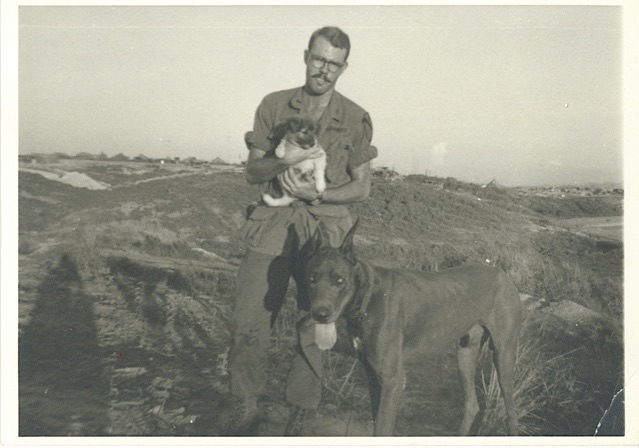
Pictured: Doug Wilson holding a puppy in Vietnam at a military base