By: Audrey Rosendahl
Flying cars are moving from science fiction toward reality, but their widespread adoption depends on solving technical, regulatory, and infrastructure challenges with recent demonstrations, like Tesla’s Oct.15 showcase, of the ambition and limits. Modern “flying cars” are most often electric vertical take-off and landing aircrafts designed to operate like cars but with the ability to take off and land vertically without runways. Flying cars exist in small numbers worldwide, with only a few models currently in production and most still in prototype or testing stages.
The “flying” Tesla Roadster is led by Tesla’s Vice President of Vehicle Engineering, Lars Moravy, with Elon Musk as the public face, and SpaceX engineers contributing the thruster technology. These cars use multiple rotors for lift, advanced avionics for navigation, and high‑energy‑density batteries for range.
“The Oct. 15 Tesla demo is a symbolic step, but true flying cars will require decades of coordinated progress in technology, infrastructure, and policy.”
While technology is advancing, there are some major obstacles to this idea. For example, regulating airspace management and implementing the new safety rules for all vehicles. It seems unrealistic for the world to adapt to a new way of driving. The rules of driving have pretty much been the same since cars were first invented. Changing this would have a crucial effect on society. This also is an expensive project and would cost a fortune to put into place.
On Oct. 15, Tesla showcased its “flying” concept with a vehicle that demonstrated aerial mobility and integration with autonomous systems. It highlighted Tesla’s vision for autonomous, multi‑mode transport, but did not present a road‑and‑air capable car ready for mass production. This event showed the limitations that it will take many years to perfect the ability to fully control these vehicles. However, the future will be gradual with development, starting with specialized services before personal flying cars become common. The Oct. 15 Tesla demo is a symbolic step, but true flying cars will require decades of coordinated progress in technology, infrastructure, and policy.
Overall, flying cars are becoming more realistic, but they remain a work in progress. The near future will see limited, regulated services. The long‑term vision depends on solving the technical, regulatory, and societal challenges ahead.
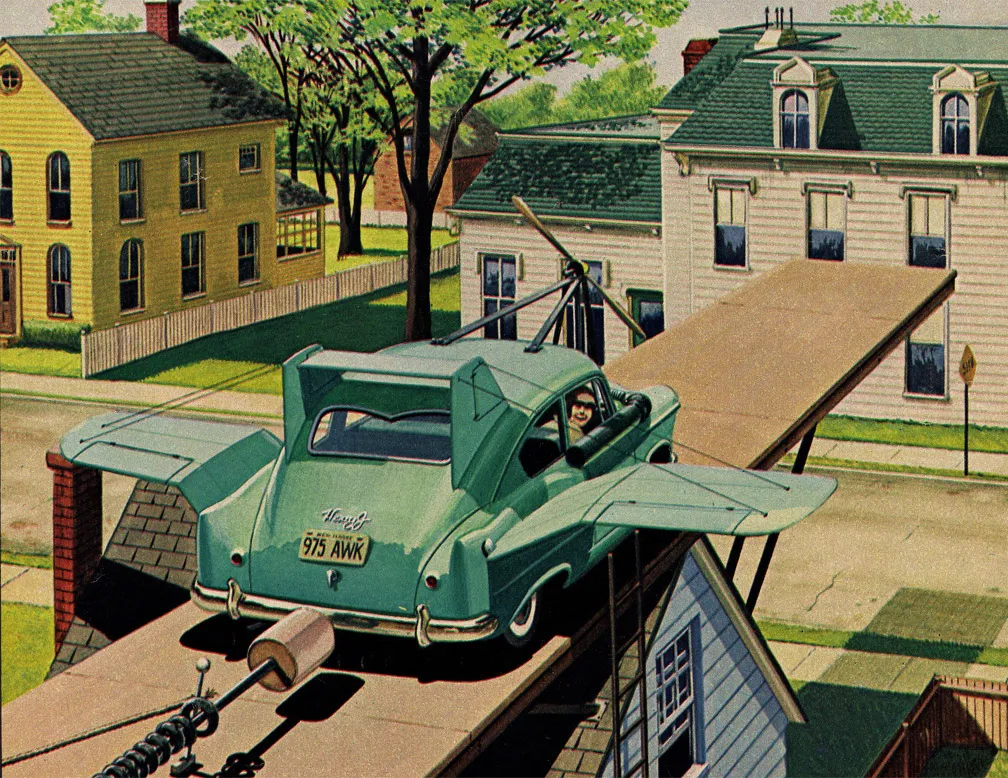
Pictured: 1950s futuristic flying car